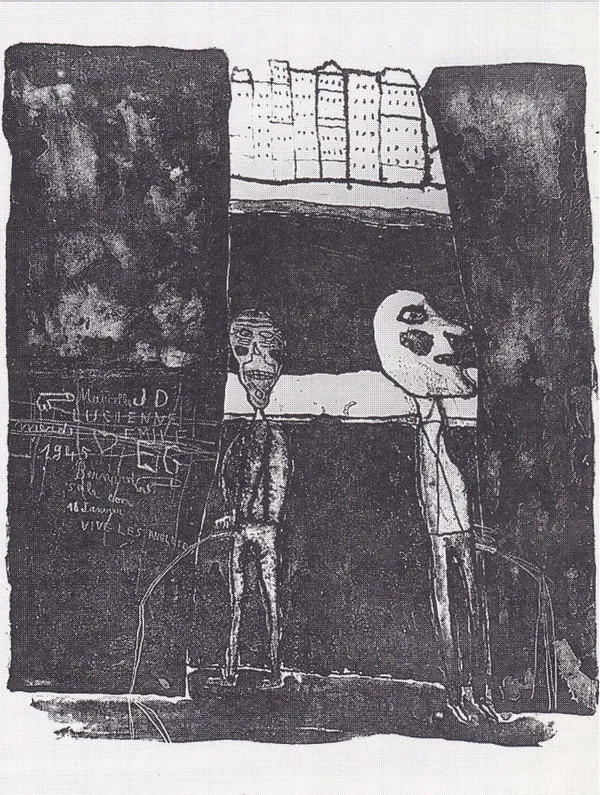
Jean Dubuffet Le Havre, France, 1901-1985

Jean Dubuffet (1901–1985) was a French painter, sculptor and printmaker whose radical approach to art fundamentally challenged established artistic conventions. After briefly studying at the Académie Julian in Paris, he abandoned formal training and initially worked in his family's wine business. It was not until 1942 that he decided to devote himself entirely to art, embarking on a career that would profoundly influence post-war European art.
Rejecting academic tradition and conventional ideas of beauty, Dubuffet sought inspiration in children's drawings, graffiti, outsider art and everyday life. He believed that authentic artistic expression existed outside established cultural institutions, leading him to coin the term Art Brut to describe works created beyond the boundaries of the traditional art world. Throughout his career, he continuously reinvented his artistic language, experimenting with painting, sculpture, works on paper and printmaking, as well as unconventional materials and richly textured surfaces.
Dubuffet's work is characterised by its remarkable diversity and constant spirit of experimentation. Rather than pursuing a single style, he repeatedly challenged his own achievements, developing new visual languages that ranged from expressive, heavily textured paintings to simplified graphic compositions and monumental sculptural environments.
Today, Dubuffet is regarded as one of the most influential artists of the twentieth century. His pioneering ideas transformed perceptions of artistic creativity and continue to shape the understanding of contemporary art. His works are held in the collections of major museums worldwide, including the Centre Pompidou, Paris, the Museum of Modern Art, New York, Tate Modern, London, and the Solomon R. Guggenheim Museum, New York.
-

Jean Dubuffet
at Gallery Sofie Van de Velde 17 Oct - 22 Nov 2026 New SouthRead more -
Artist portfolios
at Gallery Sofie Van de Velde 5 Sep - 11 Oct 2026 New SouthThe collaboration between artists and writers in the creation of portfolios and illustrated books dates back to the fifteenth century. The oldest known illustrated book is the Egyptian Book of...Read more