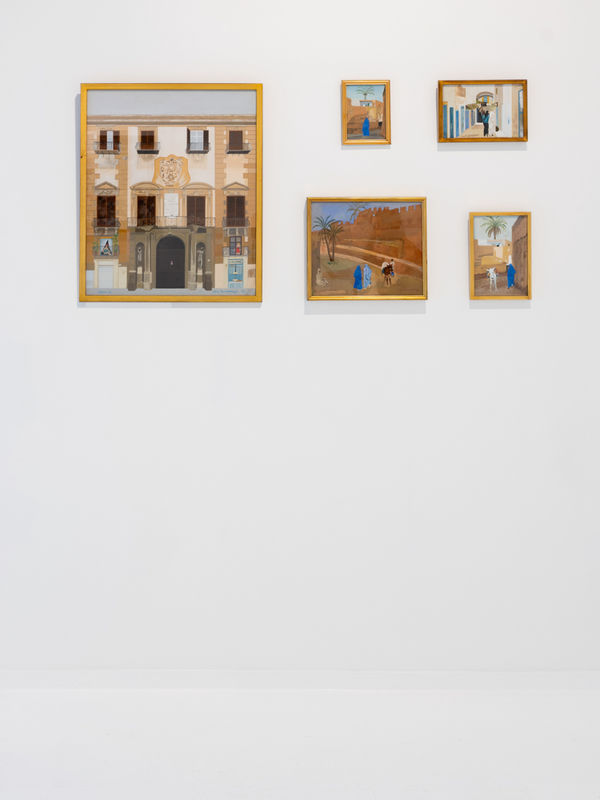
At a time when the collective is increasingly fragmented into individual perspectives, the question arises of what we still remember together. Experiences are shared, but rarely in the same way. What remains is not a single, unified narrative, but a multitude of impressions, emotions, and traces. As it remains emerges from precisely this tension: how collective moments settle in memory, not as facts, but as residue.
What remains after something has happened?
The exhibition brings together a selection of paintings by Eline Rausenberger (1944) depicting events that anyone may experience, yet never in the same way. A demonstration, a market, a football celebration, a public auction… These are moments that belong to shared life, but that take shape differently in each individual memory. The focus is not on the event itself, but on its aftermath: atmosphere, silence, tension, remembrance.
In these works, the community appears as a plurality. Rausenberger paints crowds and groups without reducing them to anonymity. Each individual retains significance within the whole. Her paintings often contain hundreds of figures within a single composition, rendered with care, without hierarchy or a dominant viewpoint. The scenes are recognisable, yet open-ended: they offer no fixed interpretation, only space for projection.
This approach is closely connected to Rausenberger’s way of life. She grew up in an artistic environment in Antwerp, yet consciously developed an autonomous practice. She received no formal training in painting and was encouraged at home to follow her own path, so that her spontaneity could remain intact. As a self-taught artist, painting is for her a way of seeing: attentive, observant, without intervention.
Her oeuvre can be read as a pictorial record of her own life. Everything she paints is something she has experienced or closely observed. Not as a protagonist, but as a quiet participant. She regularly depicts herself in her paintings, recognisable by her striped clothing: present, yet never central. Her work may be understood as a way of participating in life indirectly, by registering what unfolds between people rather than directing it.
Despite her autodidactic path, Rausenberger received early recognition. In 1970, she and her husband Jacques Vandewalle were awarded a state grant for a residency at the Cité des Arts in Paris. In the years that followed, she received several major distinctions, including the First Prize for Flemish Painting (1971) and the Medal of the European Painting Prize (1975). Her work later fell into relative obscurity, making a renewed perspective today all the more relevant.
As it remains marks Rausenberger’s third exhibition at Gallery Sofie Van de Velde. The exhibition highlights how her work, though rooted in personal experience, offers a strikingly contemporary reflection on collective memory, loss, and time. In a world where meaning is increasingly fixed and reduced at speed, these paintings invite us to slow down. To allow what remains, and to embrace what it leaves behind.